


The Wisdom of Circles
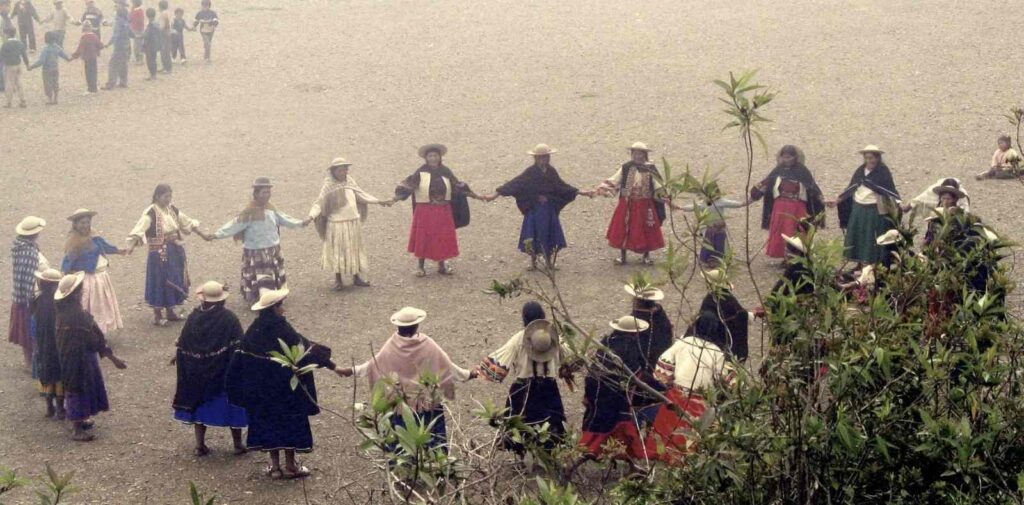
I am very inspired by circles and all things cyclical. For 4.5 billion years circles have been good enough for planet Earth, so I think there is something in that. The natural world and the human body work in cycles and I believe people do their best work together sitting in circles, facing one another as equals. Although we have been under the spell of linear thinking for several centuries, our culture is now slowly returning to the idea of circular ways of doing things, with for example the promotion of the circular economy, which mimics natural cycles and allows nothing to go to waste. Circles are full of possibility, full of mystery, they evoke the timeless and ephemeral, they allow creativity and sustainability, they contain yet do not limit. Whenever you walk into a Full Circle Change workshop, you’ll find yourself sitting or standing in a circle, and you will be able to see the face of everyone you are learning with and from.
circles in nature
Circles are omnipresent in the natural world. In ‘The Good Ancestor – How to Think Long Term in a Short-Term world’, Roman Krznaric writes that in the 1930s the Oglala Sioux leader Hehaka Sapa or Black Elk, spoke of his circular conception of time and of the cosmos.
‘Everything an Indian does is in a circle, and that is because the Power of the World always works in circles…. The wind in its greatest power, whirls. Birds make their nests in circles for theirs is the same religion as ours. The sun comes forth and goes down again in a circle. The moon does the same and both are round. Even the seasons form a great circle in their changing, and always come back again to where they were. The life of a man is a circle from childhood to childhood, and so it is in everything where power moves.’
Honouring and living close to the cycles of nature, of seasons, of death and rebirth, of the ebb and flow of tides, of ovulation and menstruation and of the movement of the sun and stars was the only way of life for most of human history and is still practiced by indigenous people the world over. Many of us now have electric lighting, central heating, 9am-5pm indoor work, abundant non-seasonal food all year round, tampons, rapid transport and GPS navigation and many other conveniences that uncouple our survival from these natural cycles around us. Unlike our ancestors, we do not need to be tuned into nature and its cycles to make it through each day and each year. However, in the midst of all these conveniences, when we seek solace or inspiration we often turn to nature. There is something very telling in the way our bodies long for and thrive in natural settings. A Finnish Forest Research Institute study found that people began to feel psychologically restored after just 15 minutes of sitting outside in a the park or forest and another study found that spending at least 120 minutes a week in nature is associated with good health and wellbeing. But it is hardly surprising that the place the human body feels most at home in is, erm, its home. It took us 6 million years to evolve into modern humans, and cities were only invented 11,000 years ago. As recently as 2007 half of the planet still lived in rural areas. It is no wonder then that we don’t feel at home in concrete. We have found ways to survive at a distance from nature but perhaps not quite thrive.
sustainable = in tune with nature
Many people of course would argue that it is a fallacy to say that since humans became ‘civilised’ we haven’t been thriving. Of course, there are many aspects of modern life that allow deep fulfilment, enquiry, comfort, self-actualisation, abundance, and pleasure. Moving away from the confines of natural cycles has opened immense possibility. For a few centuries, and especially since the end of the second world war, a relatively small but growing number of people on the planet have enjoyed less physical toil, longer healthier lives, less violent conflict, more than enough food, education, travel and all the trappings of modern life. Yes, we’ve made great strides and on many levels. But they have come at a price. Much of this success/progress/change has been gained thanks to the exploitation of people and other life forms in poorer parts of the world. And there is one other quite important indicator of our success or lack it, and that is that fact that we are hurtling towards the annihilation of all life on Earth, including our own. Not exactly a huge endorsement for the way we’ve chosen to progress, live, develop or whatever other term one might use. I believe that as we distanced ourselves physically and culturally from nature, we found it easier to forget we rely on natural systems to survive. Like the frog in boiling water, we haven’t been aware of how our changes are damaging us as. We’ve been too seduced by the spoils. But in places like Greenland and Ladakh, where these changes were forced in people over a short period of time, it is obvious how cataclysmic they are to the human psyche.
And if we look to the cultures on the planet which have managed to live sustainably, we find that they are the indigenous ones, the ones who live in tune with the cycles and seasons, the rhythms of nature. Though of course in the 21st century, indigenous people have adopted technologies that have benefitted them, the elders in many cultures continue to teach new generations about reciprocity, not taking too much and honouring the Earth as a living being and all life on it, now and in the future. Cultural practices, festivals, myths and stories reinforce this message on a daily basis. Many North American Native American cultures, for example, are influenced by the Seventh Generation principal which says that
In the modern ‘developed’ world on the other hand, we are told that we are consumers more often than citizens, we hear messages such as ‘because I’m worth it’ associated with hair products, we are bombarded with thousands of ads a day which give us the message that our self-worth and status is tied up with the products we consume. At the same time, we are told we should be doing our bit to save the planet, but how can we accommodate these opposing messages without confusion, guilt and feelings of powerlessness?
the linear economy or the circular economy?
The economic model which has given rise to much of the industrialisation which has allowed a minority to live a materially abundant life in the recent past has been based on the opposite pattern to that found in nature. It has been a linear system of production. It is summarised this way in ‘The Story of Stuff’.
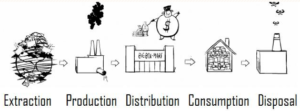
This system has been hugely environmentally and socially destructive. At the disposal end, possibly most visibly, it has given rise to incredible amounts of waste on the land and in the oceans. Thankfully there are rumblings now of a move to a circular economy. The EU, as well as some governments and corporations are trying to find ways of implementing a system of production which drastically reduces the amount of waste, instead relying on reuse, repair and recycling. And with less reliance on new raw materials, there would be less mining, pollution and habitat destruction. This circular system resembles how in nature everything breaks down and rots and contributes to the growth cycle of the next season. Nothing is wasted, everything is interdependent, and everything has its own place and purpose in the system. This system, combined with perhaps with another circular idea, Kate Raworth’s Doughnut Economy, could help create a safe and just 21st century.
Moving away from the extractivist model is also essential with regard for how we related to ourselves. Extactivism is about plundering the earth for more and more raw materials with no regard for limits to these supplies, nor for the people living in the areas mined for their underground riches. We have internalised this capitalist idea and we often treat ourselves, our bodies and psyches, as entities to be mined incessantly in the name of productivity. Burn-out and chronic stress has become endemic as we live in the ‘always on’ culture and as we try to prove ourselves in the workplace where going home on time or taking extended maternity leave can cost you in terms of career progression. Even in activist circles, amongst people who want to change the system, there is a tendency to ignore our bodies warning signs – the increasing anxiety, irritation, sleeplessness and so on, which are signals that things are getting out of balance and rest and reflection is called for. In nature this is all built in. In different ways according to where you are on the planet, night fall, hibernation and the cycle of seasons allow for rest and regeneration. However, since the commodification of time and the concept of the factory line, we have been tied to the external clock and not our circadian rhythms. No wonder so many of feel out of sorts, tired and unbalanced.
learning in circles as equals
So how do circles help people to work, learn and relate? Angaangaq Angakkorsuaq the shaman and healer from Greenland says that in his culture, they sit in circles so that ‘we can’t see each other’s backs, only their beauty’. There is indeed something beautiful about gathering around with a group in circle, to sing or to share conversation. It is conducive to sharing, to a sense of equality, to deep listening, to hearing each voice equally, to a sense of the collective, to allowing things to emerge. In contrast, the traditional classroom, with its little rows one behind the other, and the authority figure, the deemed holder of the knowledge in the front, is a more hierarchical model, based on the idea that learners are empty banks into which knowledge must be placed by the teacher. Yes, individuals who have studied or who have expertise can share and pass on their knowledge, but studies have shown that people only retain about 25 percent of what they hear. In contrast, when people are encouraged to share their life experience and opinions, that dynamic interaction can challenge and provoke questioning in people, allowing internal shifts in perception. I believe that when it comes to learning about and exploring questions of sustainability, justice and change-making, that we all have something to say and that circles allow us to exchange with each other freely and easily. As the song says:
We shall be known by the company we keep
By the ones who circle round to tend these fires
We shall be known by the ones who sow and reap
The seeds of change, alive from deep within the earthIt is time now, it is time now that we thrive
It is time we lead ourselves into the well
It is time now, and what a time to be alive
In this Great Turning we shall learn to lead in love
In this Great Turning we shall learn to lead in love
organising in circles
One perpetual barrier to change-making is how to get a group or organisation to move beyond the inevitable conflicts, power struggles and personality clashes which can really derail and delay action. Can circles help human get things done as collectives in a fair and efficient way? A radical form of dynamic governance developed in the Netherlands in the 1980s which I have some experience of learning and using, is sociocracy. It organises people into circles and is partly inspired by natural systems. The way that circles relate to one another in sociocracy mirrors the way systems work in the natural world. Circles are decentralized, nested systems that are semi-autonomous. That means they are both autonomous and dependent on each other, like, for example, the respiratory and the nervous system. Sociocracy considers human needs and psychological safety and meetings usually open with a check-in, a brief sharing of how each person is before business is attended to. As Pamela Boyce-Simms says:
Finally, change is not linear. Change is cyclical and iterative. Much of the wisdom we need to draw on for our individual, collective and planetary wellbeing is held by the elders on the planet and in the practices we are relearning from the past. We will blend these with new ideas coming forth from the youth, new discoveries, and technologies, come up with novel ideas and solutions only to revisit and add to them multiple times before they are optimised. There is movement in circles and it isn’t only one way. We have been too limited by the linear, too focused on constant innovation without heed for what has come before. With circles we can move forward bringing wisdom from the past with us, we can involve everyone and change on multiple layers. Circles connect us to nature while allowing us to innovate.
Please join Full Circle Change on an inner and outer journey of transformation for people and planet.
Comments:
-
-
Rachel Dempsey
Thanks Paula, glad you liked it 🙂
-

paulafrancesgalvin
This is a wonderful read, thank you