


Cultural and Spiritual Transformation in Response to the Climate Criris
“I used to think that top environmental problems were biodiversity loss, ecosystem collapse and climate change. I thought that thirty years of good science could address these problems. I was wrong. The top environmental problems are selfishness, greed and apathy, and to deal with these we need a cultural and spiritual transformation.” Gus Speth, American Lawyer & US Advisor on climate change
This is an audacious remark, but it is true the current approach to solving the ecological and climate crisis is not working. The UN environment agency has now said that there is “no credible pathway to 1.5C in place”, and the only way to limit the worst impacts of the climate crisis is a “rapid transformation of societies”. The richer nations and individuals on the planet are more responsible for and more empowered to act on the ecological crisis, yet even in the face of a horrific future for most life on the planet, they have largely refused to do so. In the meantime, ordinary citizens have either looked away or felt powerless to respond. For decades the orthodoxy has been that we can continue to grow the economy in more or less the same way as ever, while cutting emissions and reducing pollution. That is, we can have our cake and eat it. This is like putting a plaster on a suppurating wound. We face an existential threat and cannot fix our problems with the same thinking that caused them. Instead, as Seth states, we need a deep retrofit of our beliefs around what it means to be human and to live well.
When many people think about our failure to address climate chaos, they blame human nature and sink deeper into apathy, despair and inaction. This is flawed thinking. For the vast majority of our 250,000 or so year history, we homo sapiens have lived largely within ecological boundaries and in many cultures and contexts have chosen to distribute power and resources within groups, and not just as hunter gatherers, as shown in the Dawn of Everything, by anthropologist David Graeber and archaeologist David Wengrow. We are not pre-ordained by our genetics to organise ourselves in any particular way as a species. Although the ecologically destructive dominant global order of today has been in the making for a few centuries, it is the product of certain beliefs and policies which are no more or less representative of the human psyche as those of Indigenous people for example. At 5% of the global population, there are more Indigenous People on the planet than there are US citizens and although diverse, most have a deep reciprocal relationship with the natural world. Consequently, though they occupy or use a quarter of the world’s surface area, they safeguard (or at least attempt to) 80% of the world’s remaining biodiversity. So, is human nature that illustrated by the Kogi of Colombia who consider themselves ‘the elder brother, the guardians of all life on Earth’, or by the CEOs of Exxon-Mobil who lied about the link between global warming and burning fossil fuels?
The problem which we need to deal with to solve the ecological crisis is not who we are at our core, it is who we think we are. We have forgotten that our modern, industrial way of living is, in the grand human scheme of things, completely bizarre, new and untested. We forget that the now dominant global worldview and socio-economic system has been so heavily influenced by the culture of one small region. Although Europe represents only about 8 percent of the planet’s landmass, from 1492 to 1914, Europeans conquered or colonized more than 80 percent of the entire world. The dominant culture has been built up by suppressing most of the wisdom accrued by human beings surviving on this planet for thousands of years. While the resulting global capitalist consumer culture has given many of us material benefits, it can leave us bereft in terms of finding meaning and purpose beyond acquisition, status and comfort. Our economy and material comfort is predicated on the exploitation of natural resources, other animals and indeed people (think sweatshops and child labour), which leaves many feeling both guilty, anxious and empty. Instead of mitigating against a propensity towards greed, we have elevated this one human trait into a fundamental driver of our economy and of our lives (aka the market). And the rationale that justifies all of this is the idea that humans are self-motivated, competitive creatures; we are superior to other life forms; nature is an inanimate resource bank for humans and life is a race to acquire power and money, currently being won by certain rich ‘developed’ countries while others lag behind.
To combat ecological destruction and climate change we must go back to the fundamentals of what it means to be human on this planet. As Seth says, we need a cultural and spiritual transformation. It is no longer enough to focus solely on tech solutions to reducing emissions, we need to involve all sectors, and especially the creative ones, in creating a new life-sustaining ecological civilisation. We need to discern what are our true needs and how to meet them by blending the best of what the industrial and technological society has given us with the wisdom of older, more successful cultures. We need to retire the tired old ‘I think therefore I am’ paradigm we inherited from the likes of Decartes in the 17th century and find a globally relevant one to take us from the precipice. Most of what we need to inform a new way of life has been around for thousands of years, the idea that humans are of nature and not above nature, that all life is equally valuable and interconnected and delicately balanced, that what happens the Earth happens to all life on it and that to live a good life we need to think of what we leave behind for the next generations.
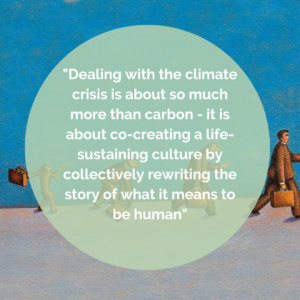
Instead of letting despondency about who we are and what we have done takeover, we need to fall back in love with humans, with life and with the living world. Margaret Soloman Klein talks about how the spiritual poverty of the separation-based consumer culture we live in has inured us to death and destruction. We need to pull ourselves out of this necrophilia and find the sacredness in life again. And we can start this process right now by re-connecting to each other and sharing our feelings about the crisis, reconnecting to nature and attending to our more intrinsic human needs (e.g., for beauty, awe, meaning, belonging and rest). Dealing with the climate crisis is about so much more than data and carbon dioxide, it is about co-create a life-sustaining culture by collectively rewriting the story of what it means to be a human on this planet.

Leave a Reply