


the work that reconnects and what it can offer
The Work that Reconnects is an open-source experiential framework and group work methodology founded by eco-philosopher Joanna Macy. This group process work developed in response to the terror people felt during the arms race between the US and the USSR in the late 1970s, to help people face planetary crisis together and to explore powerful, people-led solutions. Today it is more relevant than ever. In the face of climate breakdown, conflict, ecological overshoot and staggering inequality, this work draws on spiritual principles, myth and ritual, creativity and shared enquiry to free people from the apathy, fear and despair that prevents them taking action to help co-create a life sustaining planet.
The Work that Reconnects is heavily influenced by deep ecology, a philosophy pioneered by Norwegian Arne Naess which celebrates the Earth as a self-organizing living system and recognizes the inherent value of all life forms. It also weaves in principles from systems thinking, Buddhism and Indigenous ways of knowing. At the core of this work is the recognition that the institutionalised sustainable development agenda has failed to combat climate breakdown and inequality and that the deep transformation of society that is now needed includes a change in how we see ourselves as humans within the wider web of life.
The benefits to participants and organisations
All of us are affected by the current ecological and geopolitical situation. Whether it is through the cost of living consequences, the negative news cycle, a sense of despair about the future or a fear of escalating social polarisation and violence in society, we are all affected.
For those that work in environmental or climate related organisations there is a particular risk of burn-out and eco-anxiety from engaging with often worrying trends and statistics. For public and corporate organisations who are trying to reduce emissions and foster staff or wider behavioural change, Work that Reconnects can help cultivate agency and creative problem-solving, helping teams align around a shared, purposeful mission. It also helps participants to view challenges through a broader ecological and systemic lens, fostering critical thinking and a more long term vision of change. For a wider public the Work that Reconnects can help transform concern about the state of the world into action. Most people know about the crises we are in and care (EPA research suggests that 81% are worried about climate change, including 34% who describe themselves as “very worried”) but values and information do not necessarily translate into action. It is very important to foster a sense that it is worthwhile getting involved in individual and collective changemaking as it positively contributes to mental health outcomes, to community resilience and environmental outcomes. Certain action helps us reduce harms but initiatives like tree planting, supporting cycling, learning participative decision making, growing food and many more will also help us navigate a more precarious future together.
What are the workshops like?
On a practical level, the Work that Reconnect consists of practices and accessible and adaptable rituals organised in four stages, called the Spiral of the Work that Reconnects. These can be done with groups over the course of a few hours, a half day, a full day, a weekend or an ongoing series of workshops. The stages of this reiterative practice are:
-
- Coming from Gratitude: Participants reflect on what they appreciate in life. This grounds the mind, opens empathy, and builds a stable base for deeper work.
-
- Honouring Pain for the World: People acknowledge grief, anger, fear, and sorrow regarding ecological and social suffering. Expressing this pain proves that we are interconnected with the world.
-
- Seeing with New Eyes: Participants gain a fresh understanding of their relationship with the universe. They gain an increased sense of personal power and a deep connection to past and future generations.
-
- Going Forth: Individuals decide how to act and commit to building a sustainable, life-sustaining society.
The style of the workshop can be adapted to the audience. For work-based teams for example, they can involve pair work and reflection rather than ritual and deeper emotions focused work. For arts and creative groups and organisations, more movement, singing, poetry or other art forms can be included.
Is Active Hope the same as the Work that Reconnects?
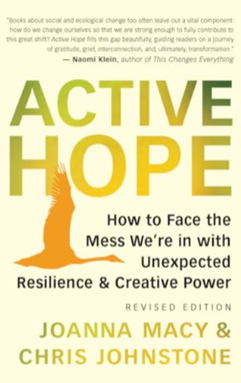
Sometimes the word Active Hope is used almost interchangeably with the phrase, ‘Work that Reconnects’. Active Hope is the name of a book co-authored by Joanna Macy and is one of the intended outcomes of the Work That Reconnects (WTR). In essence Active Hope is something you do rather than something you have or feel. It offers an alternative to a sense of apathy, disempowerment or denial and involves actively choosing what you want to see happen and then take steps to help bring that future to life.
What led me to the Work that Reconnects?
For reasons unknown to myself, as a teenager I became fascinated by world cultures, human rights and environmental issues. I became obsessed with the state of the planet, subscribed to National Geographic, joined Amnesty International and the African National Congress (this was during the apartheid era), and, more humbly, my secondary school Green group. I jumped on any opportunity I could to learn more about the world, in its beauty and its injustices. At times this meant pretending to be more religious than I was to avail of Christian focused trips and pretending to be older than I was to get into training meant for youth workers rather than the youth….
This passion led to running student activist societies, taking direct action, living in Colombia and later, working on musical and eco-social justice projects with many communities around the world. Over the years I have gained over 20 years’ professional experience delivering development education (global citizenship training) for leaders, community workers and activists around ecological and social justice issues. Alongside this engagement with wider, external issues, my parallel fascination for many years has been more internal. I’ve always been interested in our inner worlds of human beings, our psychology, what helps us heal our wounds, our culture, our music and creativity and our inner landscape.
Over the years I’ve dabbled in various therapies, practices and modalities from yoga to meditation to acupressure and more, but for me the most effective and profound way to access our internal world and psyche is through group singing and voicework. Singing collectively is a way to simultaneously be present in oneself, and at one with others. For many years I’ve led singing for wellbeing workshops, and in the early 2000s I did an MA in Ethnomusicology (the anthropology of music). For that degree I delved in to the fascinating world of how sound, voice and music are used for healing around the world. I’ve since sung with (and learnt from) many communities from around the world and researched the link between music and personal and collective change.
These worlds, the healing and arts spaces and the activist spaces, have often felt at odds with one another and I do remember, especially back in the early 2000s, having to counter those who argued that only direct ‘political’ work was important and that cultural exchange and the arts were light, fluffy and ultimately not going to change the world. Over the years I often experienced a sense of discomfort, of having one foot in the activist space and the other in the healing arts and wellbeing space. In healing spaces I’ve sometimes been told my work is too political and in activist spaces, I’ve been told it isn’t political enough.
For me, the Work that Reconnects has helped me to find a way of integrating these two passions and approaches and find others who share the conviction that both inner and outer work are important. I believe that we do need to focus on the atrocities and injustices that are happening in Ireland and around the world and demand change from the powerful and to do that, we need to urge individuals to act, protest and campaign in response. However, we ALSO need to look inwards so we can collectively change our culture and ways of being in the world. In 2025, I completed a Masters in Climate, Justice and Sustainability and wrote my thesis on the inner dimensions in the sustainability transition. Both structural/external and inner dimensions approaches have their benefits and shadow sides (to be explored in another post) and for me, the optimal approach is a combination of the two.
What is the difference between Global Citizenship Education and Work that Reconnects?
Circling back to my education work….
As mentioned above I have decades of experience in global citizenship education (GCE), which used to be known as ‘development education’. This work, often linked to development or campaigning organisations, aims to:
“empower learners of all ages to understand interconnected global challenges and actively build more peaceful, just, inclusive, and sustainable societies”.
GCE has in fact much in common with the Work that Reconnects in that both aim to empower participants to take action to bring about a more just and sustainable society. I would argue however that GCE has much more of an information component while WTR focuses more on giving space to emotions, spirituality (explicitly or implicitly depending on the facilitator and setting) and the use of ritual and myth. They are distinct approaches and both are needed.
I recall quite clearly the time when it become essential to make more space for emotions in my education practice. Going back about 7 or 8 years ago, it was 2018/2019, the hay day of Greta Thunberg’s Fridays for Future movement and an exciting time of huge global interest in climate and sustainability. I was immersed in GCE with a strong sustainability focus while employed at a community development project in Dublin’s inner city. My job was dominated by rolling out trainings such as ‘Healthy Eating without Costing the Earth’ and ‘Zero Waste Educator Training’ to hundreds of organisations around the country, and in my own time I was managing Ireland’s largest environmental Facebook group, spending my weekends involved in a sustainable co-housing project, chairing the Conscious Cup Campaign and co-organising Fridays for Future protests in Greystones.
Little by little I noticed that the tone of the online and offline conversations around ecological breakdown was changing. People were talking about societal collapse and possible human extinction. There was the hope that XR and mass mobilisation would bring change and parallel exhaustion with repeated disappointments with COP meeting outcomes. It felt like the 11th hour. Participants in my workshops were hungry not only for learning how to influence others to change their ways but also for safe spaces to articulate the complex emotions they had about what was happening. I realised that even those of us involved in activism and environmental education were not sharing the terror and grief that we often felt about the crisis with others. Gradually I opened space in my workshops for gentle sharing around our eco-emotions. I could sense this was needed as participants seemed relieved to be able to talk about their doom-scrolling habits, their loneliness in their worry, their ambiguity about having children, their guilt at not being able to do more and so forth.
These experiences catalysed my exploration of the world of regenerative sustainability, an approach which goes beyond traditional sustainability by ‘actively restoring, renewing, and revitalising natural and social systems rather than just minimizing harm’. I was delighted to discover the work of eco-philosopher and environmental activist Joanna Macy whose ‘Work that Reconnects’ group process work helps to bring us back into relationship with each other and with the self-healing powers in the web of life. I began to connect with like-minded others through the Active Hope Network of Ireland, founded by Claudia Tormey, and to participate in training for trainers in this approach.
My Work that Reconnects practice
Since discovering this work and approach I have woven it into my sustainability and indeed group singing and forest bathing practices. I have also worked with various NGOs and arts organisations delivering Work that Reconnects workshops or inputs borrowing from the approach. I am an active member of the Active Hope Network in Ireland and have been on the organising committee of two of the annual facilitator’s retreats.
My personal approach to facilitating the Work that Reconnects draws on various strands of personal and professional experience including
-
- a decolonial lens informed by 35 years + of solidarity work with Latin American eco-social justice movements, ethnomusicology studies and practice, travels and work alongside refugee and migrant communities in the UK and Ireland
-
- group singing facilitation (group singing is a strong part of the WTR, with a body of songs to accompany all the stages of the spiral)
-
- an awareness of somatic and energy work informed by three years tutor training in Capacitar (holistic body-mind work) and research/practice/training in voice and sound healing
-
- experience of change-making and training others to do the same via facilitating in the global citizenship education/education for sustainability space
-
- deep knowledge of climate justice and sustainability issues (a first-class masters and decades of engagement)
-
- experience helping others deepen their relationship with nature and see themselves as part of nature via forest bathing practice (I trained as a guide in 2021)
-
- a strong systems thinking lens from training (systems thinking and regenerative design literacy training with Gaia education) and life experience and work practice
Some of the organisations I’ve worked with
I’ve delivered WTR/WTR informed inputs for various organisations including:
- Friends of the Earth
- Irish Museum for Modern Art
- An Taisce
- Irish Environmental Network
- Irish Doctors for the Environment
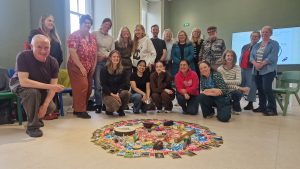
Please get in touch if you would like to discuss a Work that Reconnects or similar workshop for your group, team or organisation.

Leave a Reply