


can music foster justice and belonging? ideas for educators and teachers
Although music is ubiquitous in the world, we really don’t fully understand how powerful a tool for positive change it is. Almost every time we watch something on our phones or walk into a shop, we experience music being used to sell or entertain. But can music and singing be used by non-musician singers and teachers to bring people together, challenge dominant narratives and contribute to eco-social justice?
Music and singing for transformation
Over the years I have witnessed music being harnessed to support the marginalised or foster healing in many situations and contexts. I’ve researched how voice work is used to process trauma and I’ve documented the role of samba in the shanty towns of Rio to foster community pride. In Australia I recorded a track about land rights with Aboriginal teens and in Mali, I witnessed how the Festival of the Desert was an important symbolic expression of the place the Tuareg people hold within the Malian state. Whether on a personal, collective or global level, music is a powerful tool for healing, resilience, expression, awareness raising and uniting people around a cause.
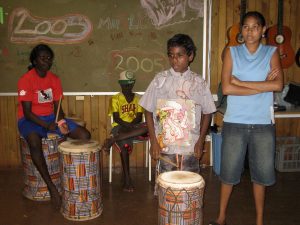
In my own workshops and projects, I use singing to promote wellbeing, intercultural understanding and connection to nature, and I founded the Singing for Change project to encourage people in Ireland to sing in the streets to call for ecological and social justice. I’ve also led workshops and trainings for teachers, teachers in training and community leaders to empower them to use music in Global Citizenship Education, Education for Sustainable Development and Intercultural Education. In January 2026 for example, I delivered a short training for primary school teachers in MIC Limerick with Global Village Schools who organised a one-day event exploring creativity ways to promote justice and belonging at the primary level.
Barriers for educators in the use of music and singing
What I have noticed however, is that many teachers and educators/leaders don’t see themselves as musical and are afraid or feel unequipped to bring music and singing into their projects and classes. In almost all cultures since the beginning of the human story, collective singing, music making and dancing was seen as an integral part of being human. John Blacking’s book, How Musical is Man, speaks to our innate musicality, and how it has been lost and obscured through the Western obsession with individual talent, virtuosity and performance.
Singing is one of the most therapeutic and connecting activities we have at our disposal and should be seen as a human right and not be limited to those who happen to sing ‘well’ without effort. In our primary schools we assist those who need extra support with literacy, yet societally we can often dismiss many as lifetime non-singers. I would love to see teachers and educators either be brave enough just to get their classes singing despite not believing they have a great voice, or get the right support to teach simple songs from many cultures to their learners, regardless of vocal talent. You Tube is very handy as you can play songs and display the lyrics and you don’t have to sing on your own if you feel nervous about this. Karaoke backing tracks can be used as a support singing in the class for more popular songs. I have collaborated with Friends of the Earth on two singing projects during which we rewrote lyrics to popular songs to focus on the climate crisis. This is also an accessible way to bring issues to life using music. If you are introducing songs from other cultures to learners, a good way is to play a soundscape from the city or region first, and many of these can be found on YouTube. This one from Senegal is an example.
If you are an educator or facilitator reading this, feel free to get in touch and as I would like to organise more trainings and/or monthly newsletters to support this.
Especially in these divided times, singing and music can be used in classrooms and workshops as a less threatening ‘way in’ to discussions of difficult issues, such as racism, human rights and other issues around social and ecological justice.
Why music and singing are powerful tools for positive change
So why use music and singing in the classroom to promote positive change? One of the super-powers of music is that it is a holistic medium which reaches us at multiple levels, including cognitive, somatic and psychological. Many of the societal issues we face cannot be tackled at the purely cognitive level. Racism, discrimination and othering for example, have two components, biological and political/socio-cultural, and music is a tool which can engage learners at the level of feeling as well as thinking.
The nervous system and ‘othering’
The human nervous system evolved over thousands of years when we humans lived as hunter gatherers. Living in small tribes and bands of people we knew and trusted from birth, we were wired to be suspicious of anyone who wasn’t familiar. Modern neuroscience has shown how the human brain’s natural tendencies towards social categorisation and threat detection contribute to the mechanisms underlying racism and social polarisation. These mechanisms are compounded by social constructs. Constructs such as white supremacy avail of the neural pathways through which cultural and social biases are learned and expressed. In other words, when we encounter people who we perceive as ‘different’ in terms of culture, race, gender identity etc, our nervous systems can react with a fear or stress response, and this can appear to support narratives which suggest certain groups cannot be trusted. None of these tendencies are fixed however, as the brain’s plasticity allows for the rewiring of these neural pathways through new experiences, education, and conscious effort to override biases.
Whether or not we are susceptible to fear-based responses is also a function of our level of wellbeing, current and ongoing. Here’s an illustration. Last year I brought my then 11-year-old to Paris for a few days. I remember we were walking through one of the markets in an African neighbourhood in Paris and my highly sensitive son became completely overwhelmed by the unfamiliar smells, music and accents. We had to leave immediately. The reason he ‘melted down’ was because he was tired and hungry and has some sensory processing difficulties, making this encounter with unfamiliar stimuli really challenging. Imagine however, that I had told him that his response was the fault of the Africans we had encountered? He may well have embedded that memory as ‘proof’, both somatic and cognitive, that African neighbourhoods were to be avoided, or worse, that Africans were not to be trusted.
Our ongoing level of wellbeing is also a factor. We also know that people who are chronically stressed, marginalised or who carry intergenerational trauma can live in a heightened state of vigilance (hyperarousal) and with a reduced sense of safety. This means they are more likely to perceive a sense of threat, which coupled with damaging social narratives, can perpetuate cycles of fear and polarisation. Stressed or traumatised people are more susceptible to developing prejudices or adopting biased, protective, or avoidant behaviours towards other groups. This urge to reject that which is unfamiliar, and people who are different, can be amplified by hate and fear mongering and Social Justice Ireland (2024b) report that disadvantaged and marginalised communities are especially susceptible to far-right disinformation.
Music and singing promote wellbeing, trust and bonding
The greater the level of wellbeing we feel, the more likely we are to act in pro-social and pro-environmental ways. In December 2025, the Colombian government passed a law known as the “Artes al Aula” (Arts to the Classroom) law. Based in existing experience where the arts have been used in post-conflict zones for reconciliation, this law transforms the teaching of folklore, music, and dance in Colombia from an optional activity into a mandatory, foundational part of the public education curriculum, recognising its role in personal and socio-emotional development and peacebuilding. When people sing together, they synchronise biologically, they release oxytocin (the human love hormone) and their nervous systems relax… which paves the way for sensitive discussions about difference and belonging. Music can regulate nervous systems, making people less reactive and for reactions based on curiosity rather than judgement. Singing is so good for our health, that people who sing regularly live longer.
We can use music to question white supremacy
Music can also challenge the unspoken (and increasingly spoken) odious narrative in our societies that white, Western nations are richer through hard work and inherent talent and that other countries are ‘underdeveloped’ because the peoples there are behind, slower or less able. The truth is that current economic differences have more to do with colonialism and exploitation, which in turn relates to differing societal priorities and circumstances over time. This myth has determined the current world order and most disciplines, including music and musicology are (or should be) going through a process of decolonialisation. Early colonial musicologists, for example, claimed that the musical scales they encountered in the Middle East and North Africa were “out of tune”, supposedly reflecting how ‘primitive’ the peoples there were.
We have moved on somewhat since these attitudes prevailed but the decolonial process is ongoing. My undergraduate degree in Latin American Studies in the 1990s involved a year living in Colombia where I explored music and identity for my dissertation. I noticed that many of the wealthier middle-class people I spoke to admired European classical music and spoke derisively about Latin popular music because of its strong African influences. I believe that European classical music, with its emphasis on the virtuosity of talented soloists echoing western individualism, is often held in higher esteem than other equivalent genres, not because it is better, but because of internalised colonialism. Many other genres around the world are equal in complexity and rigour (not that these are the only criteria for assessing music) but are not held in high regard globally, due to Western dominance. In fact, learners of musical theory in Ireland are rarely aware that they are learning European musical theory and may believe that there is only one ‘natural’ way to organise music. Although there are some physical laws of sound based on frequency, there are as many ways to organise sound into music as there are human cultures.
Although attitudes to music have often reflected racist ideologies, music can help dismantle the myth that race is biological (it is in fact a social construct) and that culture and identity are fixed. Most importantly we can challenge the idea that any social group or ‘race’ is inherently superior to another. Music (just like humans) is the story of migrations, movements and meetings, whether by force or by choice. Almost all music is either a blend of cultural influences or has echoes of timbres, rhythms, instrumentation and other elements found in other places. By focusing on how music reflects cultural change and the migration, we can see how human identity and culture are also fluid. This helps reinforce an understanding that diversity is normal, race and nationhood are essentially inventions, and that we can learn much about life on this planet by listening to how others perceive it and celebrate it though sound
Ideas (adaptable for any age group):
- Responding descriptively to music
Play samples of music from around the world to learners. Encourage them to respond by describing the music rather than judging it. At first, they can be encouraged to use adjectives such as fast, slow, loud, soft etc. and they can then be prompted to describe what happens to them emotionally, bodily, in their imagination etc. Explain how no music is either bad, good, in the same way as any given colour is not good or bad. Explain that it is ok to state whether you like a certain type of music or not but always remember that it is very difficult to like something you have only heard once. Experiment with playing a disliked genre to a class regularly and see if they change their minds.
- Guess the function
Music has different functions. Some music is great for relaxation; other music is designed to bring a community together or inspire feelings of awe or worship. Play various pieces of music with distinct functions and ask the learners to guess what these functions are. Reveal the function and discuss. If you would like help in coming up with a playlist of music for this purpose, email me.
- Questioning race and identity
Present a picture of the common instruments used in traditional Irish music. Ask which of the instruments are Irish. Surprisingly to many, only the Uillean pipes are uniquely Irish. The guitar, fiddle, whistle, flute, harp, banjo, bouzouki, mandolin and bodhran all hail from or exist in other places and are made ‘Irish’ through processes of exchange and change. Discuss the reality that Irish identity is contested and consider whether the fact that 20-22% of Ireland’s population is foreign-born will have any influence on its music and identity going forward. Play some examples of Irish music being fused with musical styles from elsewhere such as Danny Boy being played in the style of Brazilian choro (the Brazilian population is a large and growing one, now at 27,000 according to the 2022 census).
- Learning songs from other cultures
When children and adults sing songs and listen to music of many genres and cultures (including musical forms connected to Ireland) daily in school from an early age, their understanding of diversity expands. The aim here is not perfection nor performance, but the wellbeing and awareness benefits it brings.
- Musical map work
Play songs from around the world and get learners to guess where they are from. Combine with use of Google Maps/globes.
I intend adding to this article with more downloadables and videos, so keep an eye on this page. Please let me know if you’d like to stay in touch on this and be notifed when I add more resources to this page.

Leave a Reply