


The Climate as a Mirror
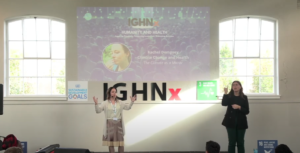
This is a transcript of a talk I gave at the Irish Global Health Network’s IGHNx Humanity & Health Conference held in Dublin on 24 October 2023. The IGHN is an Irish community committed and passionate about equity, humanity, and inclusivity and this year they decided to take a break from their usual style of conference. The event stepped away from the mainstream and delved into a world of diverse thinking, passion, and creativity. The event consisted of a variety of short talks on a range of topics related to global health under the broad theme of Humanity and Health. It was an honour to be invited to speak at the event and share the stage with 14 other passionate speakers addressing themes such as transgender rights, femicide, talking about death, caring for carers, inclusion and more.
You can watch a recording of the conference here:
****
Today I am going to talk to you about climate change but I’m going to start with a proud mother moment. So, I have two boys aged 13 and 10 and one day I was trying to get them ready for school and into the car. I’m sure many of you know the drill, you are stressed, your kids are dawdling, you’re thinking of the traffic. I was having a morning like this. My eldest son was badgering me, my younger one was taking hours to get dressed. Eventually, we got into the car, with cups of tea, school bags, bits of half-eaten toast, but my eldest was still nagging me. So I sat down in the driver’s seat and turned around to him, and in exasperation, I said ‘what do you want?’ and he responded in the funniest, least likely way I could imagine. He simply said, with a huge grin on his face, climate action. I went along with the joke and said ‘when do you want it?’ and he said ‘now!’ and we all laughed. I couldn’t believe he had dredged up that chant from his memory as he hadn’t heard it in about 5 years.
In that moment I was pretty proud of my son, who had cut through our stress with his humour, and also of myself for having indoctrinated my kids at such a young age! I jest, it was actually a bittersweet moment as it reminded me of a time when I used to bring, or more realistically, drag, my children to the local climate protests. They were incredibly stressful experiences, as both of them are neuro-diverse and have sensory issues. I remember well one afternoon I was trying to parent two dysregulated kids and lead the crowd in chants on the megaphone at the same time, and I realized that it had to stop there. I’ve never brought them to a climate protest since and never will. I wasn’t aware at the time, but I was heading towards burnout. I not listening to the feedback signals my body (and my kids) were giving me, I was pushing myself to do more for other people and more for the planet but making a bit of a mess of the world around me at that moment.
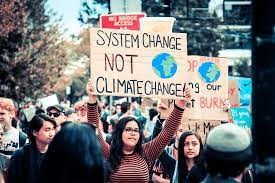
So am I saying climate protests are a bad thing? Absolutely not. We need to take to the streets to force politicians more. But we need to be discerning in which type of climate action we take at each stage in our lives, so we have the energy to keep playing our part. We also need to ask deeper questions about why we are failing in our attempts to tackle the ecological crisis. I’ve been involved in climate activism ever since I heard about global warming and joined the green group in school in the mid-1980s. Despite 28 global annual climate meetings since then, emissions have doubled and the Earth’s biodiversity and ecosystems are on life-support with 6 of the 9 planetary boundaries now crossed.
What has gone wrong? I’ve met hundreds of people through my work educating on sustainability issues and I interact with thousands of them online. Most of us are well-intentioned but we feel we’re not doing enough, either in terms of individual or political action. At one stage I was frustrated that I wasn’t living a more low impact zero waste lifestyle. But as a single working mother of two kids with additional needs, I was already exhausted with domestic life and had no energy to do more. I thought of how when I was a child my stay-at-home mum lived a relatively sustainable life without even trying. She managed to grow veg, buy local, repair stuff and walk every day. But globalisation and free trade have made commodities like flights, fuel, food, clothes and meat cheaper, so we consume more. The powers that be have designed out sustainability while at the same time putting the onus on individuals to change. People in the 21st century are being asked to live 20th-century lives, and this can be overwhelming and guilt-provoking. It is especially unrealistic for people who live with less privilege.
People in the 21st century are being asked to live 20th-century lives, and this can be overwhelming and guilt-provoking.
So these past few decades of free market economics have turned us into hyper-consumers. At the moment, if everyone on the planet lived as we do in Ireland, we would need almost two Earths. Half of the stuff and energy we use every year essentially is stolen from other people on the planet and from future generations. But the irony is, we’re using up more resources than ever, but do we experience abundance and inner peace in the process? Could we live healthy meaningful lives with half the consumption? Of course, we could. Firstly, many of those resources, are quite tragically, wasted and, from a justice point of view, we have no choice but to stop devouring what is not ours to use up. Unlike what some in Ireland think, reducing our consumption and slowing down our lives would not be a regression to some kind of barbaric Stone Age existence. And contrary to popular belief, our civilization does not represent the pinnacle of human achievement to which the entire human population aspires.

A few years ago I spent time with Jaime, a tribal leader from the Kankuamo ethnic group of Northern Colombia who was visiting Ireland. Through colonialism, his tribe lost much of their language and traditions, but many of them are choosing actively to relearn the old ways, inspired by their neighbours, the Kogi. The Kogi have, for the past 500 years, done everything in their power to live as far away as possible from those influenced by the dominant culture. Far from wanting our lifestyles, they see themselves as the Elder Brother, the guardians of the Earth. They have tried to tell us, the younger brother, that we are killing the Earth but we’re not listening. In the meantime, they are anxiously doing everything in their power to compensate for the damage, through their deep connection with Aluna, which for them is a kind of cosmic consciousness of nature, the source of all life. The Kogi desperately want to be listened to, but maybe we think we have all the answers already. Green growth is one of those supposed answers, but this sustainability light model is perpetuating damage to the planet, and to those who try to defend it. After his visit to Ireland, Juan went back to Colombia with funding for bulletproofing his office, as so many of his fellow earth defenders have been murdered because of their activism. The same is happening in the Congo region where indigenous people are being targeted by mining companies. Essentially, other people are dying for our phone upgrades and EV batteries.
So what makes indigenous people so willing to put their lives on the line to protect Mother Earth? Asking this question is a key part of tackling the climate crisis. Indigenous people see the Earth as a living being to which they belong. Where Westerners see natural capital, they see kin. Where we see iron ore they might see an organ. For them, if we keep mining and exploiting the Earth, it is like decimating a body by removing the limbs and organs one by one. And we know that when intact, nature absorbs carbon, climate action is about preserving nature as much as limiting emissions.
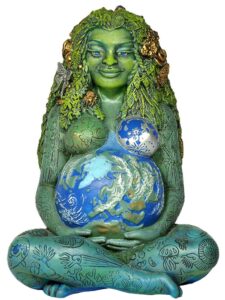
And this notion isn’t confined to the cosmo-vision of isolated tribal people. Since the Gaia Hypothesis was put forward in the 1970s many Western scientists have accepted the idea that the Earth and the life on it operate as a whole, in a manner similar to a living being. Everything on the Earth, living and non-living until recently, acted in harmony, in balance, maintaining the perfect conditions for life. Now, however, because of human activity, the Earth is no longer able to self-regulate. We are witnessing this through floods, fires, epidemics, extinctions. And when we look at us humans over the last few decades especially, we see rising chronic stress, loneliness, anxiety and nature deficit disorder. We are essentially burning out as the planet burns up. We are extracting from ourselves as we extract from the planet. We are microcosms or fractals of the Earth and everything is interconnected.
We are essentially burning out as the planet burns up. We are extracting from ourselves as we extract from the planet.
Around the same time as the Covid lockdowns, I realized that I had been experiencing burnout. It was perfect timing then for me to stop work and refocus my energy on healing my nervous system. Convinced that we need to listen to the Earth just as we need to listen to our bodies, I trained as a forest bathing guide, the many hours spent in the forest helping to restore me to wellness. My focus now is to help people reconnect to themselves, each other and to nature, to help people find nurturing ways to become better ancestors. The good news is that a huge community of people thinking more holistically about climate and human wellbeing. There are people working on regenerative cultures, resilience, trauma work, indigenous rights, natural principles, and more. We cannot solve a problem with the thinking that created it, so we need to find answers at the edges, far from the places where the problems were created.
So the next time you contemplate what you can do (or not do) for the planet, simply pause and take a long deep breath. Ask yourself how you can meet some of your intrinsic needs, such as your need for connection, belonging, nature, meaning, beauty and awe. Try to approach your activism from a place of connection instead of a place of guilt. Let’s practice filling ourselves up from the inside out, so we no longer need the dopamine hit from that Amazon order, the mini city break or the fancy new car. And let’s expand the climate conversation beyond micro-consumerist swaps and net zero, so we can collectively rewrite the story of what it means to be a human living on this beautiful planet.

Leave a Reply